When you do not need to file a tax return for rental income
There are situations in which you do not need to deal with a tax return for rental income at all:
- you have no other income and your rental income does not exceed CZK 50,000.
- while employed, your rental income did not exceed CZK 20,000
How to calculate income tax on rental income
As an individual, you pay tax on rental income at a rate of 15%. No health or social insurance contributions are payable on rental income.
- Add up your rental income, counting only the net rent and excluding energy and utility charges.
- Count only the rent you actually received in the relevant year; for example, you do not take into account that a December payment was for January of the following year.
- Deduct expenses from your income to arrive at the tax base, from which you calculate the tax.
There are two ways to claim expenses: actual expenses or flat-rate expenses. Let us look at which method is most suitable for you.
Actual vs flat-rate expenses
You can include all expenses related to generating rental income as costs. You can choose between two options:
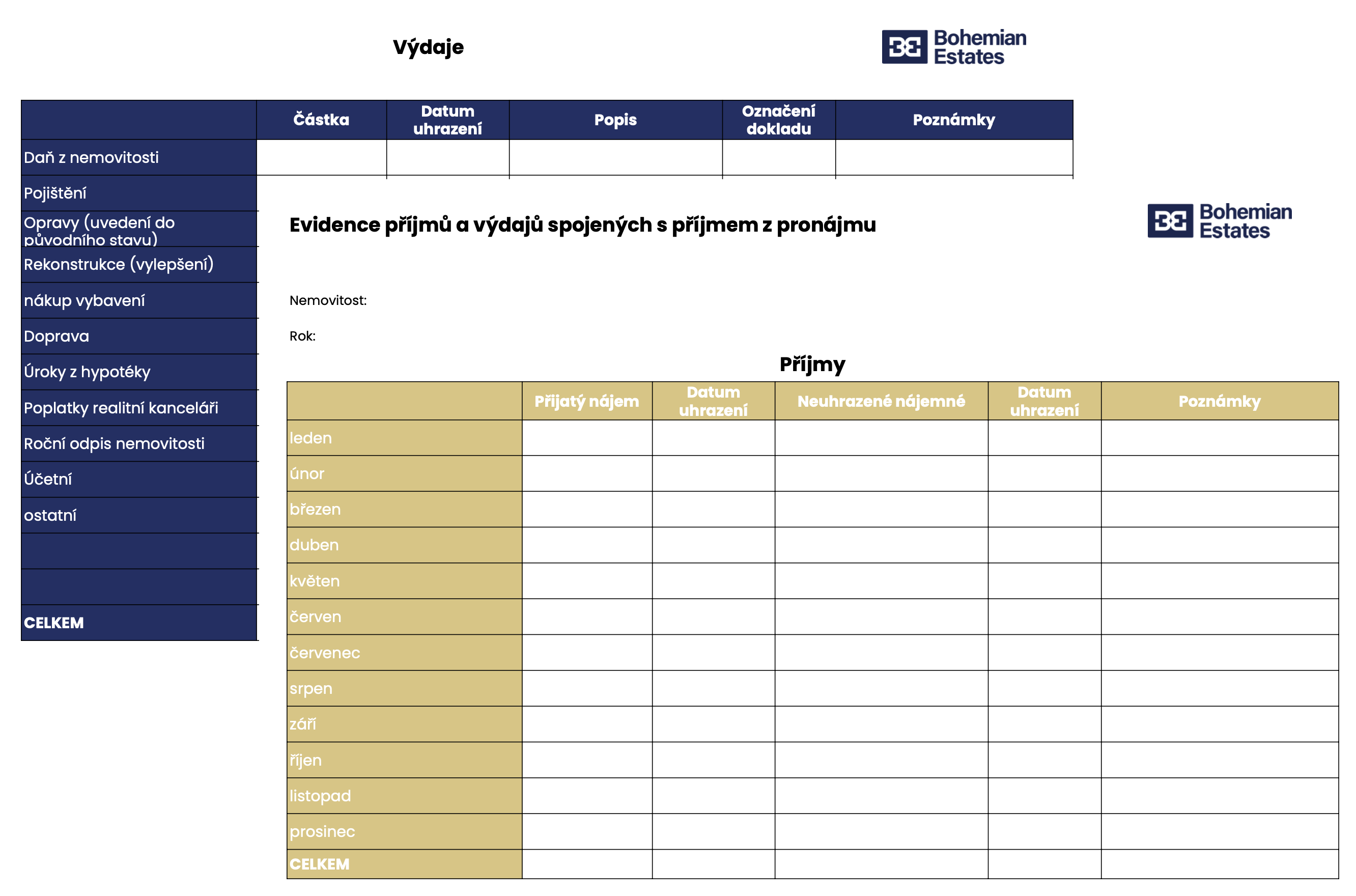
Actual expenses – actual costs which you must be able to substantiate.
Flat-rate expense allowance – 30% of income, with no need to substantiate actual costs; administratively simple, but it may not be financially worthwhile.
When flat-rate expenses are worthwhile for rental income
The flat-rate expense allowance can be claimed at 30%, up to a maximum of CZK 600,000. If income exceeds CZK 2,000,000, you can still claim only CZK 600,000 in expenses. Flat-rate expenses are particularly worthwhile if:
- You have low income and therefore low or no tax liability.
- You acquired the property as a gift that was exempt from income tax, for example a gift from family. You will not be able to claim property depreciation, which usually represents the largest expense item.
- The flat is cooperatively owned – you cannot claim depreciation (although the cooperative can).
- You have low expenses associated with renting out the property
When actual expenses are worthwhile for rental income
In other cases, it is highly likely that claiming actual expenses will be more worthwhile for you. It involves more work, but can save you thousands of crowns in tax. As a landlord, this administration may put you off, but do not be concerned – it need not be complicated at all.
Claiming actual expenses is particularly worthwhile if:
- You have high costs associated with renting out the property.
- You bought the flat – you can claim property depreciation.
- You invest significantly in repairs, refurbishment or furnishing the property.
What can be included as expenses?
Property depreciation – this often represents the largest expense item. It spreads the acquisition cost, as an expense, over several years.
Flat furnishings – the limit is CZK 80,000; above this amount, the asset must be depreciated over at least 3 years, depending on the depreciation group to which it belongs.
Refurbishment – you can claim construction work that enhances the property up to a limit of CZK 80,000. For a higher amount, it must be added to the value of the property and depreciated gradually over the years.
Repairs – you can claim any amount for repairs that restore the property to its original condition and do not enhance its value.
Travel expenses – actual or flat-rate expenses may be claimed. When using the flat-rate allowance, you must own the car.
- If you use the car solely in connection with the property, you can claim flat-rate expenses of CZK 5,000 per month,
- if you also use it privately, you can claim 80% of the flat-rate allowance, i.e. CZK 4,000 per month.
Mortgage interest or interest on any loan used to finance the property or its repair.
Real estate agency or legal fees – for example, costs associated with finding a new tenant for the flat.
Property tax – provided it has already been paid.
Property insurance.